Sunday, 26 February 2012

Robert Crosland's South American Odyssey Part 6


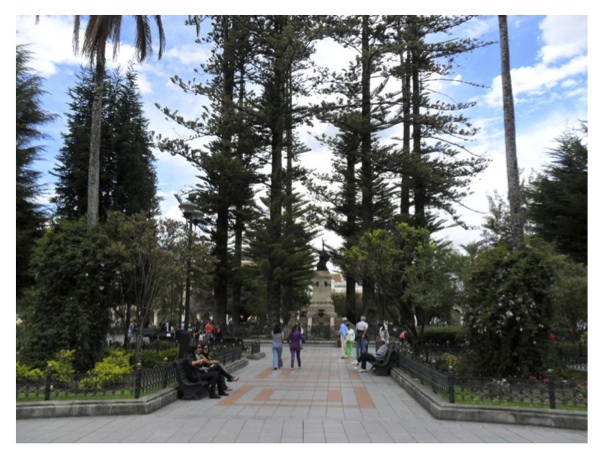
The garden space outside the school

While living in Cuenca I worked for a language school called the Center for Intermerican Studies (CEDEI). CEDEI is an academic institution dedicated to the study of American languages and cultures. Throughout the year there was always a buzzinginternational atmosphere, as students and teachers from a range of European and American countries participated in their respective language, dance or cooking courses.

The English programme itself is well developed and there are currently 700 students of all ages and levels. The majority of the students are teenagers, but I also had the opportunity to teach some adult classes. The teenage classes were challenging at first, because my students during the TESOL course were all highly motivated adults often with clearly defined goals. Some of my students at CEDEI did not share this motivation, but I had to empathise with them as I was hardly an enthusiastic language learner when I was a teenager. However, teenage classes were also very rewarding at times, due to the students enthusiastic approach to games and activities.

Robert Crosland's South American Odyssey Part 5


Montañita and Canoa
In the north of the mountainous sierra, a wide range of adventure sports can be enjoyed in Baños de Ambato, and just around the corner is Puyo, a town linking the sierra to the Amazon jungle.
Canyoning in Baños
Ecuador is one of the most biodiverse countries in the world, and each of its four regions, the sierra, the coast, the Amazon jungle and the Galapagos, can be clearly marked by their distinct climates, cultures and physical appearances. Although Guayaquil, Ecuador’s largest city which is located in the coast, is only a three hour bus journey away from Cuenca, the differences between the climate, the people and the dialect are vast.
Las peñas in Guayaquil
My favourite activity while I was living in Ecuador was actually learning Spanish, and the regional differences never failed to impress/amuse me. Cuenca in particular is a great place to learn Spanish as it is spoken very clearly there, which is not always the case in the coastal region. The school where I worked provided teachers with free Spanish lessons every week, but most of my learning came from spending time with my local friends, who were always more than happy to help me.

Robert Crosland's South American Odyssey Part 4


I already mentioned that Cuenca is generally a very clean city, especially when I compare it to some cities in South East Asia which I had visited before coming to Ecuador. However, noise and air pollution can be an issue in the centre of the city due to the sheer number of buses and taxis passing through, so it is important that teachers choose the location of their accommodation wisely. Travellers to Ecuador are often concerned about security, and sadly crime levels have increased throughout Ecuador in recent years. However, Cuenca holds a reputation as one of Ecuador’s safest cities, and I believe that this title is deserved. While petty crime certainly exists, in one year I never heard of any fellow teachers, or local friends, experiencing violent crime. With common sense and standard safety precautions, one can have a very safe and enjoyable time in Cuenca.
What Ecuador lacks in size, it makes up for in diversity. Indeed, anyone teaching English here will be spoilt for choice in terms of the activities offered by this fascinating country. In addition to visiting the colonial cities, I used to enjoy comparing the anything goes nature of Montañita, a lively beach town on the southern pacific coast that is popular with tourists from all over the world, with Canoa, which is far more rustic and tranquil.

Robert Crosland's South American Odyssey Part 3


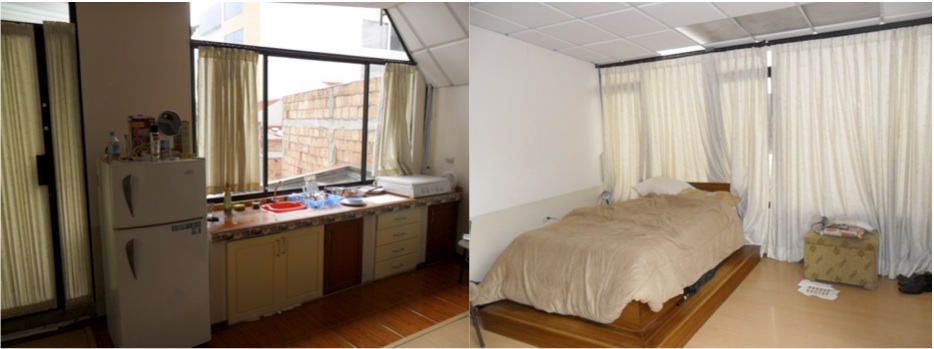
Some pictures of my studio apartment

Prospective English teachers who are considering looking for work in Cuenca will be pleased to hear that it is not a difficult place to live in. Firstly, the cost of living is still very low. One can easily rent a furnished studio apartment here for $200 a month.
It is of course much cheaper if you live with other teachers or locals. Generally you should expect to pay between $80-$120 a month to rent a room in a house or apartment. Cuenca is also a great place to eat out, and I have enjoyed many delicious and healthy almuerzos (set lunches) in the locally run restaurants located throughout the city. One personal recommendation is Cafe Moliendo, where for $2.50 you can expect soup for starters, a main course with a tender cut of beef, avocado, salad and hearty arepas (maize pancake), and a fresh glass of maracuyá (yellow passion fruit). It is even cheaper to cook for yourself if you take advantage of the local markets. I usually spent about $150 a month to feed myself. Foreigners are generally pleased to see how far their money can go in Ecuador. The only exception is electrical goods which are as expensive, if not more, than those purchased in Europe or the United states.

Robert Crosland's South American Odyssey Part 2


The historical centre of Cuenca


Inside the National Bank


In addition, it is also a modern city. Although I was definitely a little naive when I arrived in Cuenca, I remember finding it difficult to believe that I was actually in South America, and subsequent travels to other parts of the country confirmed that this is a city both charming and cosmopolitan. Despite being a relatively small city, with a little under 500,000 inhabitants, one can find a huge range of restaurants serving local and international dishes, large shopping malls equipped with all the designer brands (and the expected price tags), and a thriving nightlife served by bars and nightclubs. Here a young and stylish crowd enjoy an eclectic mixture of international floor fillers, Salsa and Meringue. Furthermore, trendy art galleries and excellent museums reflect Cuenca’s status as Ecuador’s cultural capital.

Indeed, Cuenca is becoming a popular retirement destinations, because it combines colonial beauty with an exciting, modern atmosphere.

Robert Crosland's South American Odyssey


Robert Crosland, one of Tefl Lab London trainee teachers, recently returned from Cuenca in Ecuador after teaching there for a year. He wrote about his experience there and he has kindly let us publish it on the Tefl Lab London blog. Any trainee planning to travel and teach in South America should read this as it is a very accurate portrayal of just what life is like for a TEFL teacher in South America.

With a beautiful historical centre, a mild year round climate and welcoming people, there is no doubt that Cuenca is an excellent choice for aspiring English teachers. Even after spending one year in this city, I was still impressed by the magnificent colonial architecture as I walked through the city centre, and the proud residents who worked hard to keep their city streets spotless. I still believe that Cuenca is the most beautiful city I have seen in South America.

Sunday, 1 January 2012

Silent Pronunciation Modelling 18th January Tefl Lab

Hi
I will be hosting an IPA session on silent modelling of the vowels and consonants in English. I would love to see you all there on the 18th January at 6.30pm or thereabouts.

My method is taken from what is called 'Silent Way' the brainchild of Caleb Gattegno. Adrian Underhill has successfully utilised this method and teaches using the silent model. This workshop will essentially model what he does.

Here is a link to how Adrian approaches the IPA and silent modelling.

The central question is; Is teaching pronunciation a physical act or a mental act? Grammar and lexis are often seen as mental representations of language and teachers find these 'easier to teach' than aspects of phonology. Teachers (especially non native teachers) find the teaching of pronunciation difficult. Often trainee teachers find drilling a difficult technique to master for a wide variety of reasons and often don't see the utility of it during a preliminary training course. Language learners across the world know though that drilling makes a big difference to their mastery of language.

We will discuss silent modelling and a whole lot more. I would like to talk to you about aspects of phonology such as prosody, contrastive and lexical stress and the role of teaching intonation- this is a particular challenge. I believe there is no consistent approach to teaching intonation. ELT literature offers nothing accessible to the English language teacher. We all know our learners need explicit help with intonation but there is little if not nothing on how to teach it and improve our learners ability in this area.
Here is a good website to get an idea about Silent way and improving the teaching of pronunciation


I look forward to seeing you there.

Will Tichener