Sunday, 26 February 2012

Robert Crosland's South American Odyssey Part 8


The historical centre of Quito
It should be pretty clear that I had an unforgettable experience in Ecuador due to the fun and supportive teaching environment, the outstanding diversity of the country and the sheer beauty of Cuenca, which I was proud to refer to as my home for a year. Nonetheless, an English teacher considering making the move to Ecuador needs to consider the downsides. Low rates of pay can be an issue for some English teachers in Cuenca, so I would recommend that anyone thinking of teaching English there brings a reasonable amount of savings ($2000 perhaps). This would ensure a higher standard of living in Cuenca, and the possibility to travel extensively around Ecuador. I hope you enjoyed reading about my experiences, and if you have any further questions, don’t hesitate to contact me.
Robert Crosland (robc_89@hotmail.co.uk)

Robert Crosland's South American Odyssey Part 7


My students
A wide range of courses are offered by the English programme including regular classes which follow the attitude curriculum, children’s classes, a conversation club, tutorials customised by the student to fit their needs, and preparation for exams such as the TOEFL. This variety of courses creates an excellent learning environment for both the student and teacher. Finally, the school itself is well-resourced with a plethora of materials for each level, photocopiers which rarely broke while I was there and simple yet pleasant teaching rooms.
I generally had a rich experience teaching English at CEDEI, due to the high level of support offered by my colleagues. New teachers are assigned a mentor with whom they meet regularly to discuss progress and concerns. Furthermore, a lead teacher can always be found in one of the buildings to provide support when necessary. During each 10-week cycle there are several workshops which cover a range of topics including student discipline, activities and how to teach particular skills such as reading. Due to the wide range of courses on offer and the sheer number of students, inevitably the teaching schedules varied significantly. I was fairly lucky with my teaching schedules, but split shifts can be expected as well as a Saturday class in at least one cycle per year. Teachers are usually given three or four classes to begin with. For example, two regular afternoon classes from 15h00-16h15 and 16h30-17h45 Monday to Thursday, and a Saturday class from 08h30-12h30. As this is only 14 hours a week, teachers often take extra classes and tutorials to increase their workload and pay.
In truth, the only real downside of CEDEI is the hourly wage of $6.50 which makes it very difficult to live comfortably without teaching a lot of classes. If you teach about 25 hours a week, you will earn just over $700 a month, which does not go that far even in a city as affordable as Cuenca, so many teachers work at least 30 hours a week in order to live more comfortably. I personally believe you need about $800 a month to live well in Cuenca, but this still does not include any travelling costs. Indeed, there are two week vacations between each cycle in CEDEI whereby there are no regular classes, but these are not paid. Therefore, teachers need to take tutorials or give placement tests in these weeks if they wish to see a pay cheque. Otherwise, a healthy savings account is necessary. Overall, the wages offered by CEDEI are lower than those offered by many language schools in Quito, the capital city, and Guayaquil where $10 an hour is definitely attainable. Nevertheless, in my opinion Cuenca is a more desirable place to live. Overall, South America is not a teaching destination where one can make a lot of money, but teachers do enjoy a rich cultural experience.

Robert Crosland's South American Odyssey Part 6


The garden space outside the school

While living in Cuenca I worked for a language school called the Center for Intermerican Studies (CEDEI). CEDEI is an academic institution dedicated to the study of American languages and cultures. Throughout the year there was always a buzzinginternational atmosphere, as students and teachers from a range of European and American countries participated in their respective language, dance or cooking courses.

The English programme itself is well developed and there are currently 700 students of all ages and levels. The majority of the students are teenagers, but I also had the opportunity to teach some adult classes. The teenage classes were challenging at first, because my students during the TESOL course were all highly motivated adults often with clearly defined goals. Some of my students at CEDEI did not share this motivation, but I had to empathise with them as I was hardly an enthusiastic language learner when I was a teenager. However, teenage classes were also very rewarding at times, due to the students enthusiastic approach to games and activities.

Robert Crosland's South American Odyssey Part 5


Montañita and Canoa
In the north of the mountainous sierra, a wide range of adventure sports can be enjoyed in Baños de Ambato, and just around the corner is Puyo, a town linking the sierra to the Amazon jungle.
Canyoning in Baños
Ecuador is one of the most biodiverse countries in the world, and each of its four regions, the sierra, the coast, the Amazon jungle and the Galapagos, can be clearly marked by their distinct climates, cultures and physical appearances. Although Guayaquil, Ecuador’s largest city which is located in the coast, is only a three hour bus journey away from Cuenca, the differences between the climate, the people and the dialect are vast.
Las peñas in Guayaquil
My favourite activity while I was living in Ecuador was actually learning Spanish, and the regional differences never failed to impress/amuse me. Cuenca in particular is a great place to learn Spanish as it is spoken very clearly there, which is not always the case in the coastal region. The school where I worked provided teachers with free Spanish lessons every week, but most of my learning came from spending time with my local friends, who were always more than happy to help me.

Robert Crosland's South American Odyssey Part 4


I already mentioned that Cuenca is generally a very clean city, especially when I compare it to some cities in South East Asia which I had visited before coming to Ecuador. However, noise and air pollution can be an issue in the centre of the city due to the sheer number of buses and taxis passing through, so it is important that teachers choose the location of their accommodation wisely. Travellers to Ecuador are often concerned about security, and sadly crime levels have increased throughout Ecuador in recent years. However, Cuenca holds a reputation as one of Ecuador’s safest cities, and I believe that this title is deserved. While petty crime certainly exists, in one year I never heard of any fellow teachers, or local friends, experiencing violent crime. With common sense and standard safety precautions, one can have a very safe and enjoyable time in Cuenca.
What Ecuador lacks in size, it makes up for in diversity. Indeed, anyone teaching English here will be spoilt for choice in terms of the activities offered by this fascinating country. In addition to visiting the colonial cities, I used to enjoy comparing the anything goes nature of Montañita, a lively beach town on the southern pacific coast that is popular with tourists from all over the world, with Canoa, which is far more rustic and tranquil.

Robert Crosland's South American Odyssey Part 3


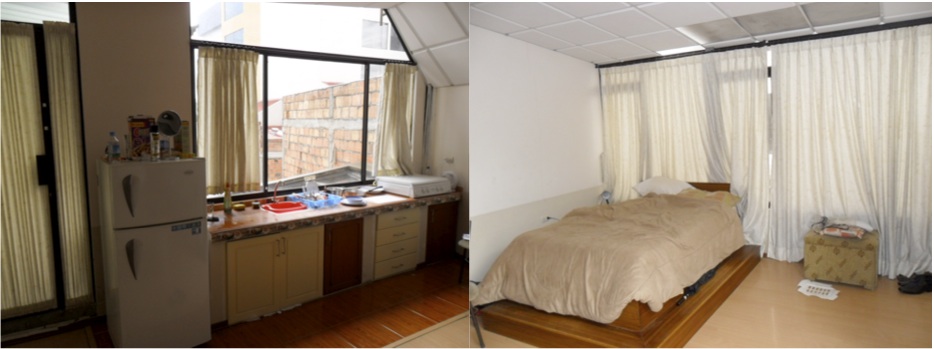
Some pictures of my studio apartment

Prospective English teachers who are considering looking for work in Cuenca will be pleased to hear that it is not a difficult place to live in. Firstly, the cost of living is still very low. One can easily rent a furnished studio apartment here for $200 a month.
It is of course much cheaper if you live with other teachers or locals. Generally you should expect to pay between $80-$120 a month to rent a room in a house or apartment. Cuenca is also a great place to eat out, and I have enjoyed many delicious and healthy almuerzos (set lunches) in the locally run restaurants located throughout the city. One personal recommendation is Cafe Moliendo, where for $2.50 you can expect soup for starters, a main course with a tender cut of beef, avocado, salad and hearty arepas (maize pancake), and a fresh glass of maracuyá (yellow passion fruit). It is even cheaper to cook for yourself if you take advantage of the local markets. I usually spent about $150 a month to feed myself. Foreigners are generally pleased to see how far their money can go in Ecuador. The only exception is electrical goods which are as expensive, if not more, than those purchased in Europe or the United states.

Robert Crosland's South American Odyssey Part 2


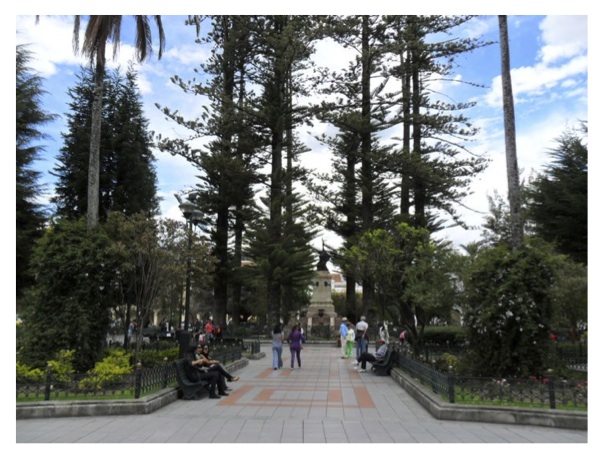
The historical centre of Cuenca


Inside the National Bank


In addition, it is also a modern city. Although I was definitely a little naive when I arrived in Cuenca, I remember finding it difficult to believe that I was actually in South America, and subsequent travels to other parts of the country confirmed that this is a city both charming and cosmopolitan. Despite being a relatively small city, with a little under 500,000 inhabitants, one can find a huge range of restaurants serving local and international dishes, large shopping malls equipped with all the designer brands (and the expected price tags), and a thriving nightlife served by bars and nightclubs. Here a young and stylish crowd enjoy an eclectic mixture of international floor fillers, Salsa and Meringue. Furthermore, trendy art galleries and excellent museums reflect Cuenca’s status as Ecuador’s cultural capital.

Indeed, Cuenca is becoming a popular retirement destinations, because it combines colonial beauty with an exciting, modern atmosphere.

Robert Crosland's South American Odyssey


Robert Crosland, one of Tefl Lab London trainee teachers, recently returned from Cuenca in Ecuador after teaching there for a year. He wrote about his experience there and he has kindly let us publish it on the Tefl Lab London blog. Any trainee planning to travel and teach in South America should read this as it is a very accurate portrayal of just what life is like for a TEFL teacher in South America.

With a beautiful historical centre, a mild year round climate and welcoming people, there is no doubt that Cuenca is an excellent choice for aspiring English teachers. Even after spending one year in this city, I was still impressed by the magnificent colonial architecture as I walked through the city centre, and the proud residents who worked hard to keep their city streets spotless. I still believe that Cuenca is the most beautiful city I have seen in South America.

Sunday, 1 January 2012

Silent Pronunciation Modelling 18th January Tefl Lab

Hi
I will be hosting an IPA session on silent modelling of the vowels and consonants in English. I would love to see you all there on the 18th January at 6.30pm or thereabouts.

My method is taken from what is called 'Silent Way' the brainchild of Caleb Gattegno. Adrian Underhill has successfully utilised this method and teaches using the silent model. This workshop will essentially model what he does.

Here is a link to how Adrian approaches the IPA and silent modelling.

The central question is; Is teaching pronunciation a physical act or a mental act? Grammar and lexis are often seen as mental representations of language and teachers find these 'easier to teach' than aspects of phonology. Teachers (especially non native teachers) find the teaching of pronunciation difficult. Often trainee teachers find drilling a difficult technique to master for a wide variety of reasons and often don't see the utility of it during a preliminary training course. Language learners across the world know though that drilling makes a big difference to their mastery of language.

We will discuss silent modelling and a whole lot more. I would like to talk to you about aspects of phonology such as prosody, contrastive and lexical stress and the role of teaching intonation- this is a particular challenge. I believe there is no consistent approach to teaching intonation. ELT literature offers nothing accessible to the English language teacher. We all know our learners need explicit help with intonation but there is little if not nothing on how to teach it and improve our learners ability in this area.
Here is a good website to get an idea about Silent way and improving the teaching of pronunciation


I look forward to seeing you there.

Will Tichener


Why Listen and repeat does not work

This post from pronsci clarifies the message about listen and repeat.


Why Listen & Repeat doesn't work
All around the world, pronunciation is taught using the ‘Listen and Repeat’ (L&R) model: the student is asked to listen to his teacher or to a recording, and then asked to repeat what he hears. Many students cannot do this successfully, but even those who can find that it doesn’t have a lasting effect on the way they speak.

This is because L&R misdirects the student's attention. Instead of focussing on what he is doing with his speech articulators and what the acoustic effect is, he is trying to copy an acoustic image. That copying process is attempted using good, bad or indifferent skills that he learnt in the past, but whatever his level of success he is not left with any insight into the mechanics of the pronunciation of the new language. He has little to take away with him at the end of the process.
Those few students who do emerge with good pronunciation from L&R classes do so because they subvert the process: they practise on their own, they watch what they are doing with themselves, and so on. The good results they achieve are achievable by all, if only we encourage these behaviours in everyone.

How we speak and breath....where does stress come from?

Here is an activity from Piers Messum and Roslyn Young. They are both members of a special interest group that discuss issues relating to pronunciation. I have added it to our blog as I think it is interesting and relevant for trainee teachers.

The issue that they have been discussing in general is whether it is a good idea to teach students pronunciation with a 'listen and repeat' model. This is the primary method used in EFL throughout the world. They question its utility. We will start with the idea of stress and timing.

1 When we speak we're normally unaware of how we control our breath (our
`speech breathing'). But in extreme circumstances, it's more apparent.
Try
saying a nursery rhyme (like `Jack and Jill went up the hill, to fetch a
pail of
water') in a loud whisper. Try saying it after breathing out almost all
of the
air that you can. (It may help to stand up for this exercise.)

a) What can you feel in the muscles around your waist?
Now go back to normal breathing and make a string of short /s/ sounds at
different rates. 4 per second, 2 per second and 1 per second.


b) What can you feel in each case in the muscles around your waist?


The idea behind the first exercise was for people to become a bit more
aware of what they do with their respiratory systems during speech.
Technically, this is known as speech breathing (SB), although the name
is a bit imprecise: we're only really concerned with the control of
expiratory ventilation rather than breathing as a whole.

When we speak under normal conditions, we use voluntary muscular
activity to inhale. Pulling down the diaphragm and expanding the ribcage
opens up our lungs, and air flows in. The muscular activity stretches
the stiff, elastic tissue in our chest walls and as we decrease the
voluntary effort this tissue creates pressure inside us as it starts to
recoil. The situation is not dissimilar to a balloon, where the elastic
skin compresses the air inside.

The pressure this creates is more or less sufficient to drive the vocal
folds and create other sounds sources in the mouth (explosions for /p/
and /t/ etc). As we `deflate' we add a bit of pressure through
voluntary muscular activity, but for normal speech we really don't
need to do much that is active with our respiratory systems. There's
a constant pressure under our vocal folds, and all the interesting
things in speech happen from the vocal folds upwards.

This changes under extreme conditions, or when we don't speak
normally. If you tried to say a train of /s/ sounds at different rates,
you probably found that at 4 per second your SB was as it is during
normal speech. But at 1 per second, you were actively compressing
yourself for each sound, and relaxing between sounds. Let's call
that a pulsatile style of SB, since you were breathing out in pulses.

Clearly your SB can be either `smooth' or `pulsatile'
even if it is normally smooth.

This is leading up to a discussion of stress. How do speakers create
routine (rather than emphatic) prominence on some syllables in English?

Among phoneticians, there's disagreement about this and disagreement
in the data. Traditionally, phoneticians said that speakers put more
respiratory system effort into stressed syllables. Some data from the
1970's challenged this, and now there are people who believe that
stress is largely created by a vocal fold adjustment (more tension means
a louder signal) plus lengthening of the syllable, while others think
that it is caused by SB pulsatility which leads to greater loudness and
length automatically.

This affects us as teachers, because it has implications for how we
should teach stress. If stress is no more than greater loudness and
length, we might be best teaching it by getting students to copy
acoustic models.

But if it involves more effort being made by the respiratory system, we
should probably start with this, and get the extra loudness and length
as a by-product of the correct actions being made by the learner.

The extra information which, we think, resolves this dilemma is
something that phoneticians have paid no attention to: the SB of
English-speaking children during the period when they learn to stress
syllables. I looked at this as part of my PhD research, and it turns out
be very significant.

Children have compliant, floppy tissue in their chest walls, not stiff
tissue. So when they breathe in and stretch this tissue there is very
little pressure created by its weak tendency to recoil. If an
adult's lungs are like an inflated balloon at the end of
inspiration, a child's is like an inflated paper bag: full of air,
but not pressurised.

Also, children can't make syllables louder just by tweaking their
vocal folds ( in the way that adults can). They have to increase their
respiratory drive for greater loudness.

So for children learning English, stress has to be the result of
pulsatile SB activity.They are making more effort on every prominent
syllable than on other ones. Stress is something they do with their
respiratory systems and larynx in combination, not just an acoustic
effect they copy with a small adjustment of their vocal folds.

This post would get very long if I went into more detail about this now,
and I think it would be better to see if what I have written so far is
clear to everyone and what questions and thoughts, if any, it
precipitates before we go any further.

The proposal, though, is that stress can and should be taught
non-imitatively: by getting students to do something active with their
respiratory systems for a stressed syllable, and for the result to be
louder and longer as a result of this. Concurrent activities like using
some other part of the body in synchrony with the stressing may be
helpful, but in this case let's get to the core of the matter and
help students to make stress in as `natural' a way as possible:
with their respiratory systems, as phoneticians in the past always used
to recommend.


Piers Messum

Friday, 30 December 2011

Living and teaching in China

Here is an interesting site. Lots of expats working in China.


Blog from China

Hi
One of our Tefl Lab trainees has blogged his experience of living and working in China. It is a very insightful and well-written blog and will give any prospective trainee, thinking of working in China, an interesting perspective on life there.


Field Guide to working and living in China

One of our Tefl Lab trainees' has written a short piece on life in China.

Taiyuan, Shanxi province, is a Chinese city like any other. Ancient, yet utterly and essentially modern. The modern entity is the product of a coal boom, and thus although there are some much-touted yet initially unapparent ancient dimensions, the place is in the main a glorified farming settlement. There are the rich coal baron types, for whom shopping malls have sprung up filled with imported luxury goods. Then there is the rest of the population, for whom such goods start at around a month's wages. There is little in the way of what might be described as a middle class, although it is growing, tending to congregate in pricey but tasteful cafes. Though some of the international fast food chains, namely McDonald's and KFC, have multiplied in the last few years, there is still no H&M or similar outside of the bigger population centres like Beijing. However, for the shopping-minded there are arcades filled with Chinese clothing boutiques and electronics (usually very reasonable, but the electronics may not be durable, and many of the clothes are pretty wacky. Cotton and leather shirt anyone?).
It may read as if I dislike the place, but after living here for the best part of a year it's grown on me. And I have received help along the way. As with most ESL teachers here, I received help with accommodation, a bank account and practically anything else I could want. Buses are around 10p at the time of writing, although taxis or bikes are perfectly viable. Overall China is more foreign-friendly than, so I've been told, parts of South America. Despite this, there is a slight tendency among a number of the fairly tiny expat community to get 'China rage,' which might be explained by culture shock if it weren't most apparent among people who have been here longer. I have no idea if this is common in other provincial cities, but there are some understandable sparks such as public spitting, defecation (nappies aren't really used here) and sometimes obnoxious behaviour from people who aren't used to a foreign face.
There are some advantages to living outside the large international cities. One is forced to pick up some Chinese fairly rapidly, and the lack of decent nightlife means at least it can be easier to save. Not that there aren't ways to abuse one's wallet. Around Taiyuan there are reservoirs, ski slopes, an enormous seated Buddha on a mountain and a famous ancient town called Pingyao; all of which are viable day trips. Getting further away is not too much trouble by train, bus, or plane – the amazing tourist destinations of China are quite accessible. In the city there are ice rinks, karaoke TV places, bowling places, pool places, massage parlours and more. Parks are something of a highlight – though my local park may be an extreme example with a gaudy in-built funfair, a video game arcade, motor and pedal boats, a small museum and even an aquarium – it still has the staples of public aerobics, elderly people kicking trees repeatedly, practicing tai chi, playing cards, playing instruments, singing songs, playing 'jianzi' (a sort of hackey-sack with feathers), flying kites or simply walking and sipping hot water. As a second-tier city, Taiyuan has its fair share of temples for those who enjoy calligraphy and other old stuff (there are churches and a mosque too). And as eating out on an ESL teacher's salary is affordable, like me many who work here have some of the best and worst gastronomic experiences of their lives. Much of this applies to any Chinese city of this size it seems; the main differences being climactic, linguistic and culinary.
Not that teachers have all that much time off to do these things. The private language schools such as the one I work for will offer around 10 days leave per year plus public holidays, which adds another 2 or 3 weeks. Universities allow more, though the pay is often lower. But, whereas university teachers work in the week, private classes are mostly during weekends and evenings, which means days off are during the week. Another difference is the students. The majority of students in private language schools are between 3 and 10 years old, with some teenagers and a smattering of adults. This seems to be broadly the case across East Asia. In a place like Taiyuan, the average ability is fairly low – though demand is high many parents don't have an excellent grasp of the language. Depending on whether one likes kids, or playing active language games that change every five minutes, this can be a positive or negative aspect. Aside from regular classes, there are marketing activities, Halloween and Christmas parties and more that teachers are expected to participate in. This past year I have also had public school classes (imagine being locked in a small room with 40 odd kids) and corporate language classes (think a similar number of office workers) put into my schedule, both a result of contracts made with the school. The school itself is equipped with electronic white-boards, as are many today, and all the other office equipment one might expect plus more. I have had little training or observation, though this can vary.
Here I have tried to give an honest impression of China as I have experienced it. Some of the better aspects include the general safety of the streets, relative freedom as a consumer, beautiful countryside, and the possibilities for Chinese acquisition (there are plenty of books and courses), whilst the worse aspects include the lack of safety standards in, say, electrical wiring, a government that makes using the Internet fully a real hassle (without a VPN there are no blogs, no foreign social networking sites, no Youtube), and a broad lack of professionalism in many areas from plumbing to medicine. It is not a hard place to live in, and can be quite an experience for those who seek it whilst here.

Wednesday, 24 August 2011

Getting it Right in the Interview

It's such a pity, when you've worked so hard to get through the TESOL course, that you, so to speak, fall at the last hurdle, by under-performing in the interview with the Trinity Moderator.
Nerves often play a part, but they don't have to. If you start to get the jitters, shift in your seat, or move your hands while speaking, so as not to clam up.

The most important thing, though, is in the discussion of your materials to use as much of the metalanguage you've learned on the course. That seems to be key.

So, when practising, ask yourself, 'How can I show the moderator what I've learned in this answer?'

It will prove invaluable to do so.

Mike


Tuesday, 26 July 2011

Here we go again!

It's hard to believe that we've just said goodbye to a full course of teacher-trainees and now we're saying hello to a new bunch. But we are. Hello!
This course is going to be tough, but it's also going to be interesting, rewarding and life-changing.
Remember, read your assignment guides carefully, try to stay on top of the course work and if you 'hit the wall' come and talk to any of our tutors. That's what we're they're for, you'll never be rebuffed because we want you to finish this course proudly holding your certificate, with a worl of possibilities spread before you. Good luck!
Mike

Tuesday, 21 June 2011

Accommodation Solutions Summer 2011


FANTASTIC ROOMS AVAILABLE !


Available short term rooms to rent in beautiful university residences throughout the summer.


We have rooms available in the following two residences Liberty Fields (zone 2 nearest tube oval) and Liberty Court (zone 1 nearest tube Barbican)


You can choose stays from one week up to 8 weeks depending on availability in the months of July and August.


Prices start at £17.5 per person per night.


Contact evaldo dutra evaldo@englishstudio.com


Monday, 20 June 2011

Accent

I recently corrected a fascinating extended essay from a TEFL Lab online trainee who, in the course of outlining the different sound systems of Hebbrew and English pointed out that certain phonemes exist in different dialects of English and not in others.
It set me thinking about how fascinating the whole area of accent is. For example, while aware of the fact that I'm laying myself wide open to charges of pretentiousness and inauthenticity, I would freely admit that I have modified my accent for the purposes of teaching.
Why? Well, it's certainly not born of any desire to 'Come over all posh, like.' I think there are two reasons: the need to provide a clear model for my students and the fact that the accent of my home city is one of the language's ugliest accents.

'They grate on their scrannel pipes of wretched straw.'

Milton - Lycidas.

If you want a full flavour of just how vile the Limerick accent is, google The Rubberbandits and you'll see what I mean...

I am, however, a proud son of the Treaty City, just hate the accent..
The funny thing is that this weekend I'll be home for my dad's 70th birthday and boy, will I 'Limerick up' for that one! I will be posting more on this subject in the coming weeks and would welcome your thoughts....
Mike

Tuesday, 31 May 2011

Spare the Rods?

Though developed initially to aid in the teaching of mathematics, the Cuisenaire Rods are one of the greatest teaching aids available to the EFL teacher.

Sadly, they're also one of the most under-utilised, as they sit forlornly gathering dust on staffroom shelves from Holborn to Honduras. In wondering why this might be, I suppose one of the biggest reasons is our association with them as sort of childish flashback to a time when our education consisted of paint, plasticine and happy animal noises!

Another reason they are eschewed may well be that teachers aren't quite sure how to use them: they perhaps feel there is a, 'Correct,' way to employ them in the classroom and perhaps don't feel like doing the training, also fearing that their students may not be enthused by them.

Well, the good news is that there is NO 'Correct' way to use the rods. The only limit to their use is your imagination.

Of course they can be used to visually parse sentences, but they can also be used to teach lexis in a more interesting way. Take , for example, one of our students' most common social outings: the nightclub.
how much more interesting it would be to actually 'construct' the night club with the rods and elicit the relevant lexis that way?
I've found this to be a far more effective method in the classroom than mere elicitation.

So, dust off those rods, bring them into class one day - and see what happens!!

Mike

Monday, 16 May 2011

The Writing on the Wall

The other night, I was lucky enough to be invited, as a VIP no less(!) to Roger Water's The Wall extravaganza at London's O2. Apart from the free food and drink and the magical door-opening power of a VIP laminate, we also had, quite literally, the best seats in the house.

What struck me very forcefully during the gig - and rather incongruously so, given the pyrotechnics, inflatable monsters and everything else on display, was the power of the written word.

The Wall is multimedia in the truest sense of the word, with projections, models and explosions complementing the music with sometimes stunning poignancy.

Amid all of this, there was a picture of, if memory serves, Messrs Cameron and Osborne, with the message 'Trust us,' emblazoned above them. Then streaking across the Wall in that crazy red Gerald Scarfe font came the message 'No f***ing way.' (No asterisks were actually used.)
Predictably, this drew a few partisan cheers, but what struck me was the visceral power of seeing those words appear, as opposed to simply hearing them.

Indeed, sitting in the VIP reception after the show and finding myself seated at the same table as the very man himself, it occurred to me that had he actually said those words, it would have been a bit crass: sort of trite adolescent posturing. I wondered if he had realised this in the planning of the show and if he knew that saying the words would be a bit lame.

I didn't ask him though. I didn't say anything. Despite the fact that there was a free bar, I left early, got in a taxi and I suppose felt relieved that I hadn't made an ass of myself...

As teachers, maybe, if we've something really important to say, I wonder how effective it might be to suddenly STOP talking and ONLY write it on the board.

I guess I'll find out in class tomorrow..

Mike